| THE
HISTORY :
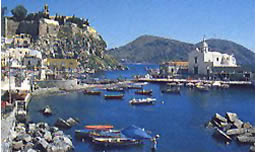
It's the biggest and most inhabitated isle; the town
council include Alicudi, Filicudi, Panarea, Stromboli,
Vulcano and some other smaller iselands. It has volcanic
origins but the craters are all extint. On the isle
there are some pomice-stone and ossidiana mines. The
interland is bare and montainous, the coast is indented
and there are some beatiful beach. The Acropolis is
really interesting, and, with the archeologic park and
the archeologic Museum, rappresent a valuable reason
to visit the isle. Infact the first settlement was in
IV millennium b.C., and in the 580 b.C. the Greeks founded
here one of the last western colony. The name of its
first king was Lipara; since 252 b.C. the Acropolis
began the first Roman town nucleus, and,
more later, in the same place the Normans built
the S. Bartolomeo cathedral. In 1544 it was
destroied
by Ariadenon
Barbarossa the pirat,
who killed many people. |
| |
|
The Spaniards rebuilt
in few years an efficient defensive sistem. A
big part of the Castle has been changed in a museum,
with prehistoric, classic,
epigraphic, volcanologic sections;
there's also a
section, speaking about
the little iselands around Lipari,
and a little
archeological park, as we saied before. The
town is absolutely a pedestrian area; the isle
is 3.4 km long and it's 40 miles to Milazzo.
|
|